Section World
Two Navy Growlers collide mid-air at Mountain Home air show; all four crew eject safely
Two U.S. Navy EA-18G Growlers struck each other during an aerial demonstration on the second day of Gunfighter Skies at Mountain Home Air Force Base, Idaho. Officials said all four aviators ejected and were being evaluated as the base locked down and investigators opened a review.
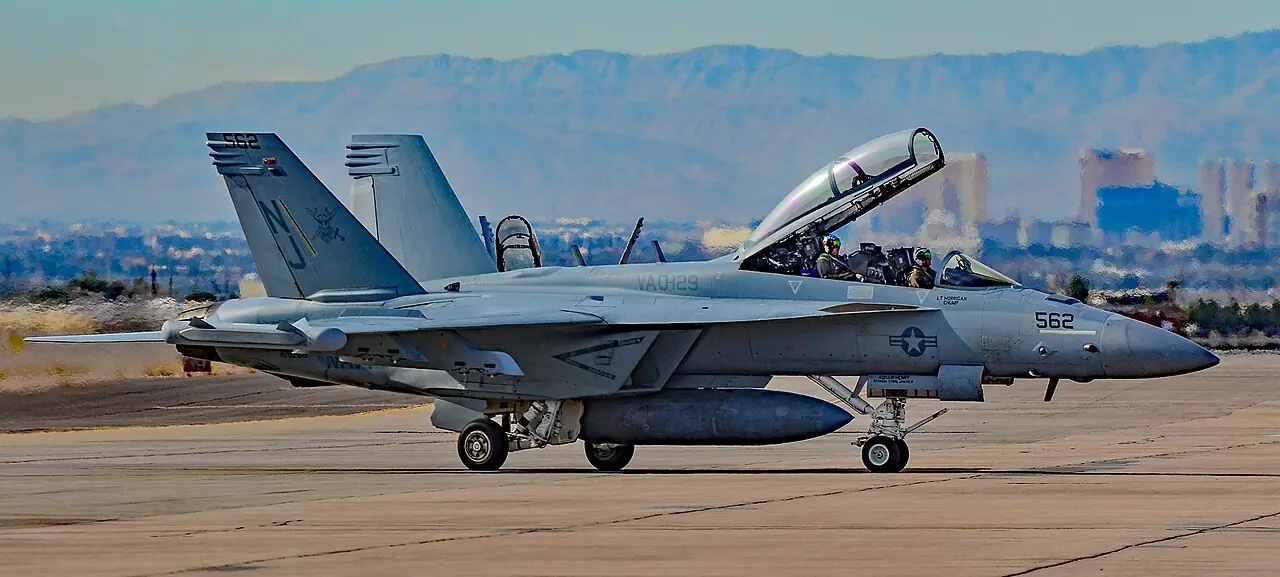
Two U.S. Navy EA-18G Growler electronic-attack aircraft collided in mid-air on Sunday during the Gunfighter Skies air show at Mountain Home Air Force Base in southwestern Idaho, according to Navy and local reporting. The impact came on the event’s second day while spectators were still on the field. Four aircrew ejected under parachute while wreckage burned on or near the installation.
Organizers and medical support teams said the aviators survived the ejections and were in stable or non-life-threatening condition as evaluations continued. Officials canceled the remainder of the day’s flying, cleared spectators in an orderly way, and closed a stretch of SH-167 so emergency crews had room to work.
What officials described
Naval Air Forces, U.S. Pacific Fleet, identified the jets as Growlers from Electronic Attack Squadron 129 at Naval Air Station Whidbey Island, Washington. A Navy spokesperson said the aircraft were in a scheduled aerial demonstration when contact occurred.
The 366th Fighter Wing, which hosts the event on the Air Force side, publicly thanked emergency responders from the base and surrounding city and county agencies for reaching the aircrew quickly and securing the scene while crowds were still on the field.
Local medevac teams said they assisted ground responders. Early readouts described injuries from the incident as not life-threatening.
What witnesses reported
Multiple spectators filming the routine captured the jets closing, touching, and then tumbling together. Ejection seats fired, and four parachutes opened against smoke over the base.
In accounts carried by local outlets, attendee Shane Ogden—who shared video of the sequence—said he had been recording because he expected the aircraft to peel apart.
In a text message quoted in local reporting, Ogden wrote: “I was just filming thinking they were going to split apart and that happened and I filmed the rest.”
He said he left the area soon afterward so emergency crews would have clear access.
Separately, broadcasters credited spectator Hannah Jungo with still images described as showing the moment of contact, with parachutes already visible in the frame.
Those witness accounts match the broad public description of the crash sequence. They are not a substitute for investigators’ radar, telemetry, or airboss logs.
Scene and aftermath
Organizers with the volunteer board that helps produce Gunfighter Skies posted that the day had turned emotional. They said pilot and crowd safety remained the priority.
Police asked the public not to drive toward the base to gawk. Transportation officials warned of multi-day highway closures tied to the investigation.
Officials described the on-base fire as contained after the initial response.
Prior incidents at Gunfighter Skies
Local television reporting published after the May 2026 crash said it was the third major incident at Gunfighter Skies in about 23 years, bracketing two earlier episodes in 2003 and 2018 that had already drawn wide attention at the same venue.
In September 2003, an Air Force Thunderbirds jet crashed during the Gunfighter Skies weekend. Later summaries of the period, published alongside coverage of the 2026 collision, quoted military officials saying the pilot ejected safely and that no other injuries were reported to the service.
In 2018, a glider pilot died during a routine performance at the same event. Base leadership at the time publicly named the performer as Dan Buchanan and described the act as one he had flown many times before; witnesses told reporters a gust of wind preceded the fatal impact, according to contemporaneous local coverage revisited after the 2026 crash.
Past outcomes do not predict the findings of the new investigation; they only show that large air shows at fixed venues accumulate a public memory of risk as well as spectacle.
What is still open
Safety investigators had not, in the first public releases, assigned a cause or a detailed sequence for the maneuver that led to the impact.
It was unclear how long flight restrictions or road closures would remain in place. This desk will update if military investigators publish a formal findings summary or if medical statuses change.
Geography and themes
Related places and recurring themes for this story.
- United States
- U.S. military
About the author
NewsTenet deskReporting desk14 years' experience
Staff-edited wire and field notes turned into clear explainers—signed when a single reporter owns the file.
Focus areas
- World affairs
- Policy shifts
- Geopolitical risk
Suggested reading
Other stories that pair well with this one—often from the same section or on overlapping themes.
Hegseth abruptly cancels 4,000-troop rotation to Poland, raising NATO reliability concerns
The U.S. defense secretary's decision to halt the scheduled nine-month deployment caught European allies off guard and follows a separate withdrawal of 5,000 troops from Germany announced weeks earlier.
U.S. indicts Raúl Castro over 1996 plane shootdown
Federal prosecutors in Miami unsealed murder and conspiracy charges against the 94-year-old former Cuban leader for his alleged role in downing two civilian aircraft.
Trump delays Iran strike after Gulf appeal
President Donald Trump said late on 18 May 2026 in Washington that he was postponing a U.S. military strike on Iran that had been scheduled for the following day after Qatar, Saudi Arabia, and the United Arab Emirates asked for time while diplomacy continued; he also told the armed forces to stay ready for a large-scale assault if talks fail.
Havana leans on self-defense law while rejecting US drone-strike talk as intervention pretext
President Miguel Díaz-Canel framed military deterrence as a lawful shield, not a war wish, after US-facing outlets amplified an Axios-style tally of imported drones; Washington’s January national-emergency declaration on Cuba still frames the island as an extraordinary threat.
Greenlandic PM says US ambitions on controlling the territory still show no sign of changing
Jens-Frederik Nielsen is pairing warmer language about closed-door trilateral talks with the same red lines Nuuk has held since winter: no sale, no transfer of sovereignty, and deep scepticism that Washington has abandoned designs on ownership even as negotiators discuss southern bases.
India says Russian crude buys track commercial logic—not Washington’s waiver calendar
Petroleum ministry joint secretary Sujata Sharma told reporters on 18 May 2026 that imports ran before, during, and after the latest U.S. Treasury carve-out, while state fuel retailers still bleed roughly ₹750 crore a day even after a ₹3-per-litre pump increase.
NATO’s largest European special-forces rehearsal opens as Trojan Footprint 2026
Roughly three thousand American and allied commandos from twenty-three countries are training from the Baltic rim down through the Balkans and into the Mediterranean and Black Sea basins—led out of Stuttgart by U.S. Special Operations Command Europe with NATO’s special-operations headquarters in the same chain of command.
Canada tightens Arctic and Nordic defense links as Greenland studies a Ranger-style patrol force
After months of U.S. rhetoric over Greenland and strained North American politics, Ottawa is deepening military procurement talks with Denmark, Finland, Iceland, Norway, and Sweden while Nuuk and Copenhagen consult Canada on adapting the Canadian Rangers model for local surveillance.
Why America feels split—and why the world can’t agree on the United States
Census and World Bank population lines, Pew’s partisan and trust batteries, inequality in the World Bank Gini series, and Pew’s Spring 2024 global snapshot: one country’s domestic fracture sitting next to a median foreign public that still tilts favourable—just not everywhere.
Trump on Truth Social: Iran’s “clock is ticking,” move “FAST,” or “there won’t be anything left of them”
Agency-backed outlets reported on 17 May 2026 that U.S. President Donald Trump posted a capitalised ultimatum to Tehran on Truth Social amid fragile Gulf ceasefire diplomacy, quoting him verbatim as tying speed on a deal to survival while pairing the message with a reported call to Israeli Prime Minister Benjamin Netanyahu.
Keep exploring
Browse the full archive or return to the front page.
Sources and external links
Sources and filings our editors consulted to verify this story. External links open in a new tab.