Section World
Drone strikes generator outside UAE nuclear plant perimeter
Air defenses intercepted two of three unmanned aircraft entering from the west, but a third hit an electrical generator near the Barakah facility, igniting a fire.
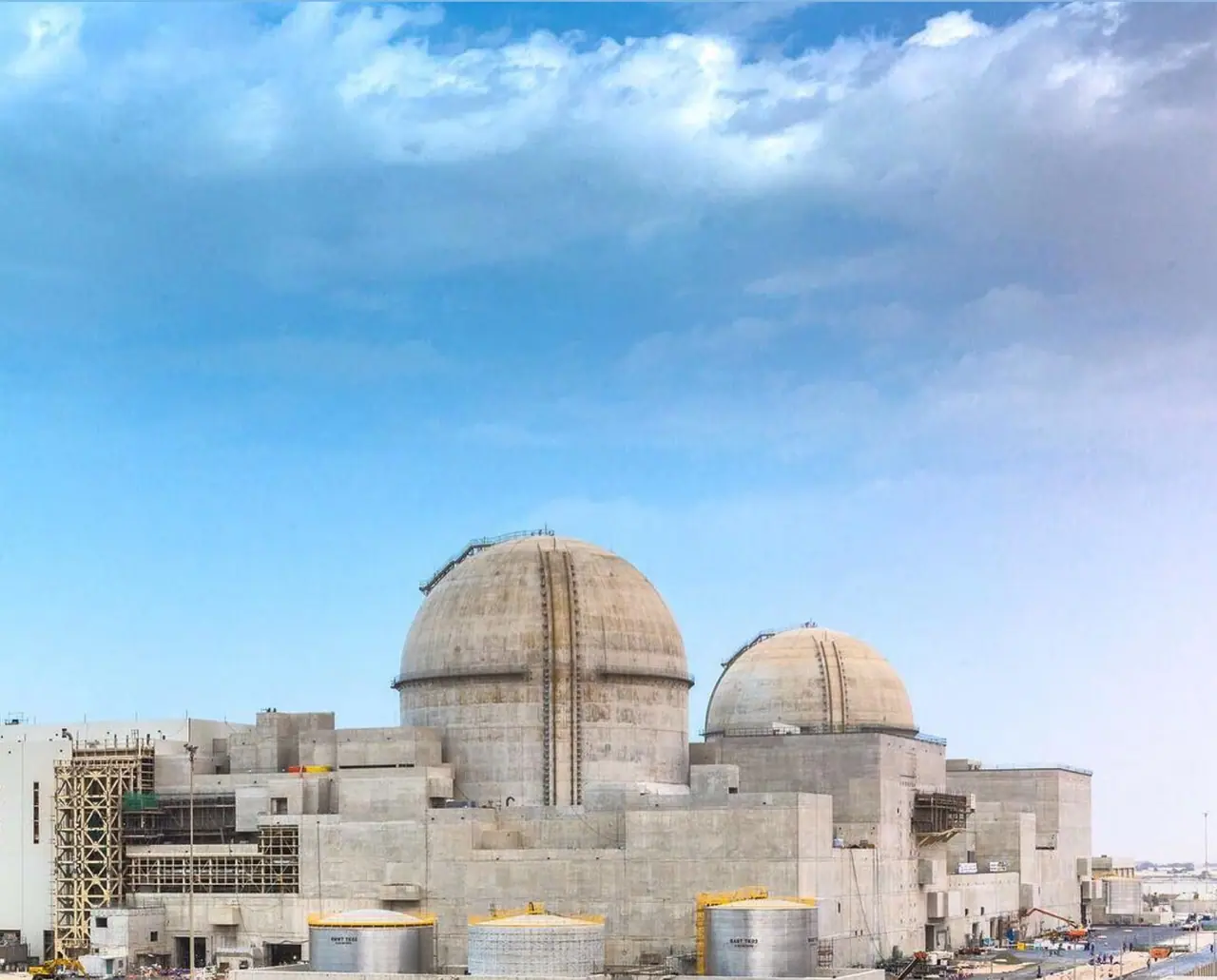
The Barakah facility is the UAE's first commercial nuclear station; this image is a pre-incident file photograph from Wikimedia Commons.
Image: Barakah nuclear power plant by Wikiemirati, licensed under CC BY-SA 4.0.
Three unmanned aerial vehicles entered the United Arab Emirates from the west on Sunday morning; air defenses intercepted two, but a third struck an electrical generator outside the inner security perimeter of the Barakah nuclear power plant in Abu Dhabi's Al Dhafra region, igniting a fire that burned until emergency crews extinguished it.
The incident marked the first targeted attack on the Arab world's only commercial nuclear facility and landed at a moment when a fragile United States-Iran ceasefire already faces collapse over unresolved disputes about the Strait of Hormuz. No group claimed responsibility, and Abu Dhabi has not publicly assigned blame, though the UAE Ministry of Defence later confirmed technical tracking placed the launch point in Iraqi territory.
The Abu Dhabi Media Office said no injuries occurred and that radiation safety levels remained unaffected. The Federal Authority for Nuclear Regulation posted on social media that all four reactor units continued operating normally and that the fire did not reach the plant's essential systems.
The International Atomic Energy Agency said the UAE informed it that one reactor briefly relied on emergency diesel generators after the strike. IAEA Director General Rafael Mariano Grossi expressed "grave concern" and warned that military activity threatening nuclear facilities was "unacceptable." The agency said it stood ready to provide assistance if needed.
Three drones, one generator hit
The UAE Ministry of Defence stated that its air defence systems engaged the three drones as they crossed the western border. Two were destroyed; the third evaded interception and hit the generator, which sits outside the plant's internal security perimeter. The ministry said investigations were ongoing to determine the source of the attack.
On Tuesday, the ministry updated its account, saying technical tracking and monitoring confirmed that the three drones involved in the Barakah incident, as well as additional hostile drones intercepted over the preceding 48 hours, had all originated from Iraqi territory. The ministry reaffirmed that the UAE retains the full right to respond under international law.
The UAE Foreign Ministry described the incident as a "terrorist attack" that constitutes a "dangerous escalation, an unacceptable act of aggression, and a direct threat" to national security. Anwar Gargash, senior adviser to UAE President Mohammed bin Zayed Al Nahyan, wrote on X that the strike "whether carried out directly by those responsible or through one of their proxies – represents a dangerous escalation and a dark development that violates all international laws and norms."
Allies condemn strike near civilian nuclear site
United Nations Secretary-General António Guterres issued a statement expressing "deep concern" and calling attacks near nuclear installations "completely unacceptable, violations of international law, and deserving of condemnation." Saudi Arabia, Oman, Qatar, Jordan, and Kuwait issued similar condemnations, with Saudi Arabia's Foreign Ministry calling the strike a serious threat to regional security.
Belgian Foreign Minister Maxime Prevot said any military activity affecting nuclear facilities was unacceptable and that consequences "can extend far beyond national borders." The World Nuclear Association confirmed that personnel were safe and emergency procedures had been effectively activated.
UAE Foreign Minister Abdullah bin Zayed Al Nahyan held telephone calls with counterparts from Saudi Arabia, Qatar, Jordan, Kuwait, Morocco, Egypt, and Bahrain. A joint statement from the ministers called the attack a "dangerous escalation and a clear violation of the United Nations Charter" and affirmed the UAE's right to respond.
Context of a fraying ceasefire
The strike came four days after the UAE reported intercepting three Iranian missiles, the first such interceptions since Abu Dhabi declared its airspace free of threats on April 9, the day the U.S. and Iran announced a ceasefire. That truce has stalled over demands for reopening the Strait of Hormuz, through which a fifth of global oil and gas shipments passed before the war.
President Donald Trump posted on Truth Social on Sunday: "For Iran, the Clock is Ticking, and they better get moving, FAST, or there won't be anything left of them." Iranian armed forces spokesperson Abolfazl Shekarchi responded that if Washington carried out its threats, the United States would "face new, aggressive, and surprise scenarios, and sink into a self-made quagmire."
Iranian state television has aired segments in which presenters appeared with firearms, and one female anchor declared readiness to "sacrifice my life for this country." Iranian officials have repeatedly warned that countries hosting U.S. military bases or Israeli-linked interests could become targets.
The Barakah plant, located roughly 225 kilometers west of Abu Dhabi city, was built with South Korean assistance at a cost of approximately $20 billion. Its four APR-1400 reactors came online between 2021 and 2024 and supply about 25 percent of the UAE's electricity. The facility operates under a U.S.-UAE "123 agreement" that bars domestic uranium enrichment and fuel reprocessing.
The UAE Ministry of Defence said investigations into the origin of the drones were continuing and that developments would be shared with the public once concluded.
Geography and themes
Related places and recurring themes for this story.
- United Arab Emirates
- Iraq
Suggested reading
Other stories that pair well with this one—often from the same section or on overlapping themes.
Trump delays Iran strike after Gulf appeal
President Donald Trump said late on 18 May 2026 in Washington that he was postponing a U.S. military strike on Iran that had been scheduled for the following day after Qatar, Saudi Arabia, and the United Arab Emirates asked for time while diplomacy continued; he also told the armed forces to stay ready for a large-scale assault if talks fail.
Iraqi militant leader “directed and urged” attacks on Americans and Jews over Iran war, feds say
Federal prosecutors unsealed a Manhattan complaint against Mohammad Baqer Saad Dawood Al-Saadi, 32, alleging he steered Kata’ib Hizballah–linked violence across Europe and North America after the wider U.S.–Iran fight escalated.
U.S. indicts Raúl Castro over 1996 plane shootdown
Federal prosecutors in Miami unsealed murder and conspiracy charges against the 94-year-old former Cuban leader for his alleged role in downing two civilian aircraft.
Aftenposten Modi Cartoon Stirs Racism Row
Aftenposten ran Halleraker’s cartoon the same day as Rossavik’s Meninger column; Red MP Rana called it racist; political editor Alstadheim told Dagbladet the symbols backed Rossavik’s point and were not meant to demean.
Cooper presses Gulf partners to reopen Hormuz routes farmers need for fertiliser
Britain’s foreign secretary has tied Iran’s disruption of the strait to fertiliser reaching African fields and wider prosperity, while parallel reporting documents urea spikes, stuck cargoes, and UN hunger modelling that treat the next planting cycles as the clock that matters.
Tehran floats Hormuz tolls on subsea internet cables as IRGC-tied media talk billions
Euronews and RFE/RL trace how Tasnim- and Fars-style outlets are packaging seabed leverage—transit fees, forced maintenance clauses, even cloud-giant localisation demands—while Mostafa Taheri, an Iranian parliamentary industries voice, throws around a headline revenue ceiling on the order of fifteen billion dollars annually that markets treated as rhetoric, not an invoice.
Tehran markets a ‘Hormuz Safe’ lane that settles marine cover in Bitcoin as war-risk premiums bite
Indian and trade-press explainers describe a new Iranian digital platform pitching blockchain-settled policies for commercial hulls threading the strait—complete with ministry talk of a ten-billion-dollar revenue ceiling—while compliance lawyers warn U.S. and EU persons that paying premiums into Iranian rails can still collide with sanctions law regardless of coin type.
Havana leans on self-defense law while rejecting US drone-strike talk as intervention pretext
President Miguel Díaz-Canel framed military deterrence as a lawful shield, not a war wish, after US-facing outlets amplified an Axios-style tally of imported drones; Washington’s January national-emergency declaration on Cuba still frames the island as an extraordinary threat.
Brazil’s TRF-1 faces a reckoning on whether Belo Sun’s Volta Grande gold license snaps back to freeze
After a single federal appellate judge revived the Canadian miner’s installation permit in February 2026, prosecutors appealed to the same court’s Sixth Panel—where the next collegiate ruling decides if the decade-old suspension logic from 2017 returns or the Pará project keeps rolling.
Brussels Brexit veterans say a UK return would mean normal EU membership, not the old carve-outs
Georg Riekeles and Sandro Gozi, among others, describe warmth toward a future application but zero appetite to recreate bespoke opt-outs; the Commission stays on this week’s brief—July summit prep—not hypothetical accession terms.
Keep exploring
Browse the full archive or return to the front page.
Sources and external links
Sources and filings our editors consulted to verify this story. External links open in a new tab.