Section Science
Europe and China count down to SMILE, a joint mission to watch Earth’s magnetic shield breathe under the solar wind
The Solar wind Magnetosphere Ionosphere Link Explorer is booked to lift on a Vega-C from French Guiana on 19 May 2026, carrying European and Chinese instruments into a long polar ellipse so researchers can link what the Sun throws at the magnetosphere with what the auroral ionosphere does in reply.
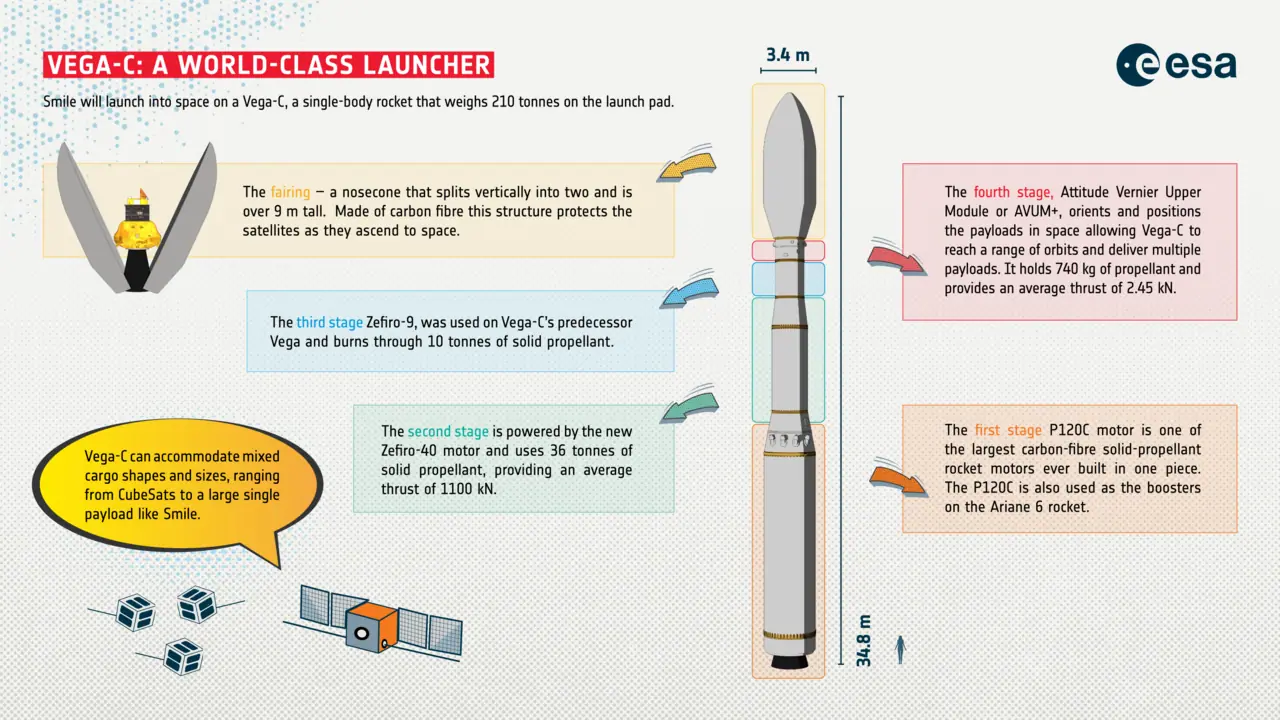
The European Space Agency and the Chinese Academy of Sciences are preparing to send SMILE—the Solar wind Magnetosphere Ionosphere Link Explorer—toward its operational orbit on Tuesday 19 May 2026, with a published liftoff target of 05:52 CEST (04:52 BST, 03:52 UTC) aboard a European Vega-C from Europe’s Spaceport in Kourou, French Guiana. Agency messaging casts the flight as the successor science thread to ESA’s Cluster quartet, which completed its science phase in September 2024, this time adding sustained soft-X-ray and ultraviolet imaging to the question of how the magnetosphere and ionosphere stay coupled during quiet spells and storms.
SMILE is structured as a joint programme under ESA’s Cosmic Vision portfolio, with Europe providing the Vega-C launch, the long assembly and test campaign that finished at ESTEC in the Netherlands, the payload module that carries three of the four science instruments, the soft X-ray imager, and shared work on the ultraviolet imager plus post-launch operations support. The Chinese Academy of Sciences supplies the spacecraft platform, partner-provided instruments, and day-to-day spacecraft operations in orbit—an arrangement that still required a single qualification and flight acceptance review before fueling and fairing close-out in French Guiana this spring.
Science goals the instruments are built around
Planners advertise four coordinated instruments aimed at how Earth responds to the solar wind—not just snapshotting auroras for their own sake but tracing mass, momentum, and energy across the magnetospheric boundary and down into the ionosphere. The mission minisite promises SMILE’s first sustained look at those linkages using X-ray and UV cameras together with fields-and-particles sensors, feeding models that still struggle to predict geomagnetic storm severity from upstream conditions alone. ESA publicly pegs an operational lifetime of about three years and notes a science community on the order of more than 250 researchers—numbers that signal how many calibration products and data-policy conversations will follow first light, not only pretty pictures.
From stack to egg-shaped orbit
The 19 May slot is itself a reset: an earlier April target slipped while industrial partners investigated a Vega-C subsystem production-line issue, with both launcher and spacecraft left declared stable while schedules moved. On flight day, four Vega-C stages are expected to separate in sequence, releasing SMILE after roughly 57 minutes; solar array deployment about 63 minutes after launch is the published success marker before controllers begin the long climb from an initial low-Earth parking orbit into a highly elliptical path that reaches about 121 000 km over the North Pole and dips near 5000 km over the South Pole—geometry chosen so ground stations can haul down wide telemetry windows while the remote sensing instruments stare at the dayside boundary and the nightside auroral oval on cadences impractical from a simple circular LEO.
Why operators beyond the lab should care
Power-grid operators, satellite owners, and aviation planners already live inside space weather products that lean heavily on a patchwork of upstream solar monitors and in-situ monitors at a few Lagrange and L1 points. SMILE will not replace those feeds overnight, but it is pitched as filling structural blind spots in how the magnetosphere breathes—how the cusp and boundary layers brighten in X-rays when the solar wind changes, and how the UV oval shifts when substorms unload stored energy. If the commissioning season goes to plan, late-2026 data should start hard-testing whether those images tighten forecasts of storm-driven currents and drag on low orbits, the mundane infrastructure risks that turn auroral physics into economic time series.
Geography and themes
Related places and recurring themes for this story.
- France
- China
- Science
Suggested reading
Other stories that pair well with this one—often from the same section or on overlapping themes.
M5.2 Guangxi quake near Liuzhou kills 2, leaves 1 missing, and pushes 7,000-plus into shelter lines
Xinhua copy carried by RTHK pins the shock to Liunan District minutes after midnight Monday local time, eight kilometers down—while wider Chinese authority briefings cited by Indian wire aggregators add the five-figure precautionary evacuations, four hospitalizations, and cracked or partly collapsed older buildings.
El Niño weather predictions: how climate outlooks differ from your daily forecast
Seasonal ENSO guidance is built from ocean temperatures, wind patterns, and ensembles of physics models—expressed as shifting odds for months ahead, not a deterministic map of next week’s storms.
Asteroid 2026 JH2 to pass closer to Earth than the Moon this Monday
The near-Earth object will fly within 90,000 kilometers of the planet, providing a rare opportunity for astronomers to study a space rock at close range.
Forecasters warn of potential "Super" El Niño this year as Pacific heat builds
Seasonal models and ocean observations point toward a strong El Niño by late 2026, reviving memories of 1997–98 and 2015–16 while stressing that timing, strength, and regional impacts still carry major uncertainty.
China’s chip ‘Big Fund’ said to be in pole position to lead DeepSeek’s first outside raise near a $45 billion tag
Financial Times–sourced reporting summarized in trade press puts the China Integrated Circuit Industry Investment Fund in talks to anchor a maiden external round for the Hangzhou lab, with Tencent and Alibaba still circling co-investor slots while Reuters-style wires floated a higher $50 billion ceiling.
Mayo Clinic validation work shows REDMOD AI spotting pancreatic cancer on CTs far ahead of usual reads
Decrypt’s April recap of the landmark study highlights up to a three-year lead in select cases; oncology trade write-ups of the same paper pin median detection near 475 days with 73% sensitivity versus roughly 39% for pooled radiologists on identical prediagnostic scans.
Trump withholds commitment on Taiwan arms after Xi warning as U.S.–China trade headlines land
President Donald Trump told reporters he would decide on a stalled roughly $14 billion arms package “over the next fairly short period,” after Xi Jinping warned mishandling Taiwan could bring the powers into conflict—while Washington and Taipei each insisted broader policy had not flipped overnight.
U.S. says China pledged at least $17 billion a year in farm buys through 2028 after Trump-Xi summit
A White House fact sheet framed new agricultural purchase targets and joint trade and investment boards as the centerpiece of the Beijing meetings, while Beijing’s commerce ministry called tariff moves preliminary and still under negotiation.
Why China’s ageing curve is squeezing workers, pensions, and property at the same time
National Bureau of Statistics year-end 2024 tables alongside UN World Population Prospects 2024 and World Bank fertility prints: what “demographic crisis” means in workers, elders, yuan growth lines, and housing—not cable-news slogans.
Putin to visit Chinese leader Xi Jinping days after Trump’s trip to Beijing
Beijing announced a May 19–20 state visit for the Russian president—Xi and Li Qiang on the schedule, a joint declaration, and Russia–China “years of education”—immediately after Donald Trump’s May 13–15 Beijing summit, the first bilateral U.S. presidential visit to China in roughly nine years.
Keep exploring
Browse the full archive or return to the front page.
Sources and external links
Sources and filings our editors consulted to verify this story. External links open in a new tab.
- Smile set to launch on 19 May (European Space Agency) (opens in a new tab)— European Space Agency
- Smile (mission overview) (European Space Agency) (opens in a new tab)— European Space Agency
- Smile approved for launch in spring 2026 (European Space Agency) (opens in a new tab)— European Space Agency