Section World
‘Lack of understanding’: India answers Dutch press-freedom questions during Modi’s Hague visit
Secretary (West) Sibi George told reporters some trade headlines shortened his reply as a lack of knowledge; on the ministry transcript he faulted a lack of understanding of India while defending pluralism, turnout, and minority population trends during Narendra Modi’s Netherlands stop.
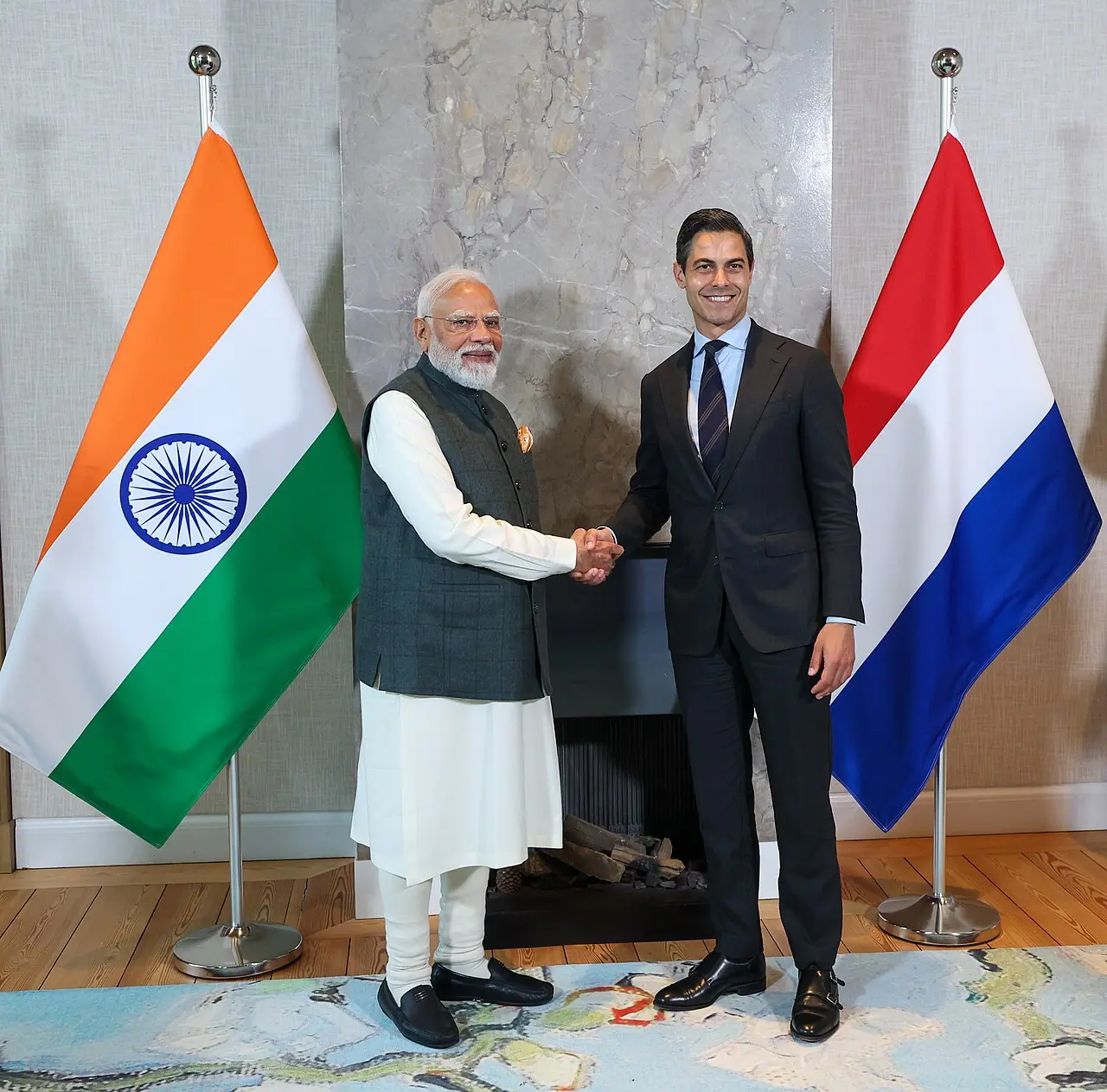
Prime Minister Narendra Modi’s mid-May 2026 Netherlands programme collided in public with uncomfortable questions about how the trip was staged for journalists and how The Hague reads India’s record on pluralism.
At a special media briefing in The Hague on 16 May 2026 tied to the visit, Ministry of External Affairs Secretary (West) Sibi George fielded a Dutch reporter who linked the absence of a joint prime-ministerial press appearance to wider worries about press freedom and the treatment of Muslim and other minority communities. George answered that such questions usually reflect a lack of understanding of the country rather than an accurate read of its politics—language that Indian trade headlines on 18 May 2026 sometimes compressed into a sharper “lack of knowledge” frame even though the ministry’s own published lines use the understanding formulation.
What George put on the record
The briefing transcript carries a structured defence of India as a civilisation of more than five millennia and a state of about 1.4 billion people today, with layered diversity. George listed Hinduism, Buddhism, Jainism, and Sikhism as faith traditions rooted on the subcontinent, noted long Jewish presence without the pogrom histories seen elsewhere, sketched early Christian arrival, and described Islam as arriving during the lifetime of the Prophet Muhammad and growing inside India’s political borders.
He then pivoted to democratic practice: he pointed to recent state assembly elections as evidence of competitive politics and characterised participation as very high in the contests he cited, while stressing peaceful transfers where voters changed the government. He also argued India had reduced poverty through democratic policy tools rather than through mass violence, and he offered a statistical contrast on minorities—asserting the minority share of the population rose from about 11 percent at independence to more than 20 percent today—as proof of inclusion rather than erosion.
Those historical and demographic claims are part of India’s standard public-diplomacy repertoire; independent demographers may parse the definitions behind “minority” in his arithmetic, but the figures are attributed here as his spoken case, not as NewsTenet’s independent audit.
What Dutch coverage had flagged beforehand
Summaries of Dutch leaders’ remarks ahead of the bilateral session, quoted across international coverage of the same week, describe Prime Minister Rob Jetten telling reporters that the Dutch cabinet shares worries about trends in India touching not only press freedom but also minority rights under strain, and that those concerns are raised regularly with Indian counterparts.
Jetten’s own social channels struck a softer harmony chord—emphasising democracy, rules-based order, and justice—while also nodding to a long-running Dutch–Indian child-custody file that predates this news cycle. The gap between the prime minister’s pre-meeting tone and the Indian briefing-room pushback is what diplomats on both sides will have to manage when parliaments and editorial boards ask whether the upgraded strategic partnership language matches the human-rights conversation each capital says it wants.
What stays open after the cameras leave
Neither side’s May 2026 messaging resolves factual disputes about media regulation, security laws, or communal violence statistics; those arguments will continue in courts, civil-society reports, and embassy démarches regardless of one press encounter.
The operational question for readers is narrower: whether the Netherlands and partners treat rights and trade as linked chapters in EU–India talks, and whether India continues to treat foreign press questions as misunderstandings to educate—or as interference to contain—when the next joint appearance is scheduled.
Geography and themes
Related places and recurring themes for this story.
Suggested reading
Other stories that pair well with this one—often from the same section or on overlapping themes.
Aftenposten Modi Cartoon Stirs Racism Row
Aftenposten ran Halleraker’s cartoon the same day as Rossavik’s Meninger column; Red MP Rana called it racist; political editor Alstadheim told Dagbladet the symbols backed Rossavik’s point and were not meant to demean.
Hargeisa fills its 18 May squares with a post-recognition parade as Herzog seals the envoy link
Nairobi- and Tel Aviv–linked reporting described thousands in Hargeisa for the usual independence anniversary—this time under the glare of December 2025’s Israeli recognition—while President Isaac Herzog formally received Somaliland’s first ambassador in Jerusalem the same diplomatic window.
Greenlandic PM says US ambitions on controlling the territory still show no sign of changing
Jens-Frederik Nielsen is pairing warmer language about closed-door trilateral talks with the same red lines Nuuk has held since winter: no sale, no transfer of sovereignty, and deep scepticism that Washington has abandoned designs on ownership even as negotiators discuss southern bases.
India’s energy stress deepens as Hormuz risk drains crude tanks and forces pump-price catch-up
Commercial and strategic crude pools tracked by analytics houses have slid about fifteen per cent since late February while refiners keep runs high; Delhi is now bridging the gap with larger Atlantic and Russian-linked programmes, excise sacrifices, citizen conservation appeals, and the first visible retail increases after months of political patience.
India says Russian crude buys track commercial logic—not Washington’s waiver calendar
Petroleum ministry joint secretary Sujata Sharma told reporters on 18 May 2026 that imports ran before, during, and after the latest U.S. Treasury carve-out, while state fuel retailers still bleed roughly ₹750 crore a day even after a ₹3-per-litre pump increase.
Canada tightens Arctic and Nordic defense links as Greenland studies a Ranger-style patrol force
After months of U.S. rhetoric over Greenland and strained North American politics, Ottawa is deepening military procurement talks with Denmark, Finland, Iceland, Norway, and Sweden while Nuuk and Copenhagen consult Canada on adapting the Canadian Rangers model for local surveillance.
‘Only four more months this government will survive’: Tamil Nadu DMK’s Anitha Radhakrishnan attacks Vijay’s TVK rule
The Tiruchendur MLA opened a southern Tamil Nadu DMK event on 18 May 2026 with that verbatim collapse line, then stretched the horizon to about six months when discussing M. K. Stalin’s return, dared TVK’s Aadhav Arjuna to resign and meet her in Tiruchendur, and reopened Kolathur and swearing-in family questions.
Why India’s megascale still strains water, cities, and budgets in the 2020s
World Population Prospects, World Bank water briefs, and Indian household-survey tables in one place: the measurable story of the world’s largest national population colliding with monsoon hydrology, irrigation demand, and urban pipes.
Trump on Truth Social: Iran’s “clock is ticking,” move “FAST,” or “there won’t be anything left of them”
Agency-backed outlets reported on 17 May 2026 that U.S. President Donald Trump posted a capitalised ultimatum to Tehran on Truth Social amid fragile Gulf ceasefire diplomacy, quoting him verbatim as tying speed on a deal to survival while pairing the message with a reported call to Israeli Prime Minister Benjamin Netanyahu.
Fire engulfs two coaches on Thiruvananthapuram–Nizamuddin Rajdhani near Ratlam; all 68 in B-1 evacuated
Indian Railways field teams halted Train 12431 between Vikramgarh Alot and Lunirichha early on 17 May 2026 after flames began in the B-1 air-conditioned coach and spread to the rear luggage-cum-guard van, isolating both cars from the rake while Delhi–Mumbai corridor traffic backed up and a relief van later crashed elsewhere in Ratlam district injuring several staff, according to Times of India reporting and official statements it quoted.
Keep exploring
Browse the full archive or return to the front page.
Sources and external links
Sources and filings our editors consulted to verify this story. External links open in a new tab.
- Special briefing by MEA on the visit of Prime Minister to the Netherlands (16 May 2026) (opens in a new tab)— Ministry of External Affairs, Government of India