Section World
Fire engulfs two coaches on Thiruvananthapuram–Nizamuddin Rajdhani near Ratlam; all 68 in B-1 evacuated
Indian Railways field teams halted Train 12431 between Vikramgarh Alot and Lunirichha early on 17 May 2026 after flames began in the B-1 air-conditioned coach and spread to the rear luggage-cum-guard van, isolating both cars from the rake while Delhi–Mumbai corridor traffic backed up and a relief van later crashed elsewhere in Ratlam district injuring several staff, according to Times of India reporting and official statements it quoted.
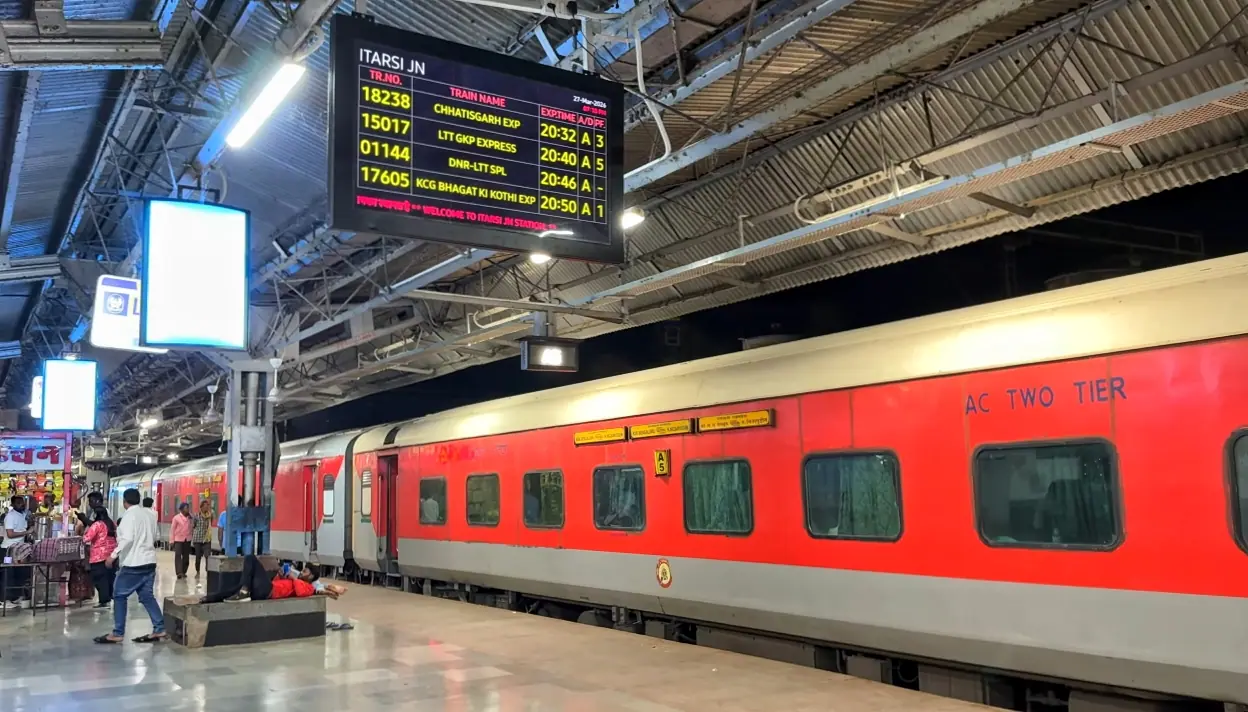
A predawn blaze on Sunday, 17 May 2026 (local time) forced an emergency stop of Train No. 12431, the Thiruvananthapuram Central–Hazrat Nizamuddin Rajdhani Express, on the busy Delhi–Mumbai trunk alignment in Madhya Pradesh’s Ratlam area. The Times of India, aggregating field accounts and railway bulletins, said flames were first noticed about 5:15 a.m. between Vikramgarh Alot and Lunirichha stations while the rake was under Kota division supervision, with smoke concentrated in the B-1 air-conditioned coach before fire jumped to the adjoining second luggage-cum-guard (SLR) vehicle at the rear.
Officials quoted in the same reporting said 68 ticketed passengers were present in B-1 and were fully deboarded within roughly fifteen minutes, yielding no passenger fatalities—a outcome creditable to train staff, Railway Protection Force teams, and villagers who reportedly helped alongside municipal fire tenders once the alarm chain completed.
Immediate safety moves beyond the hose reels
Press summaries of railway statements describe cutting overhead traction where electrification posed an electrocution risk, isolating the burning pair from the rest of the formation, and summoning district fire appliances while zonal control regulated opposing flows on a corridor that carries both premium and commodity traffic. Forensic Science Laboratory examiners were said to have been tasked with sampling burn patterns once metal cooled enough to enter safely—standard practice when insurers and prosecutors may later dispute whether ignition began in wiring looms, toilet ancillaries, or contraband stowage.
Because Rajdhani consists run premium load factors, the operational story is not only charred shelling but re-railing spare LHB shells, shifting passengers into vacant berths forward, and patching OHE if arcing damaged catenary—workstreams that can each consume hours even after flames are out.
Secondary incident that complicated logistics
A separate Times of India dispatch from Indore detailed how a carriage-and-wagon traffic van carrying relief gear toward the fire site later overturned—one version citing a cow strike on the road between Shamgarh and Suwasra—injuring more than five railway employees, with at least one person described as critically hurt before referral toward Kota hospitals. That cascade matters for accountability: convoy discipline, driver fatigue, and animal-intrusion blackspots are now part of the same after-action packet as the coach fire itself.
Western Railway help desks were publicised at Nagda, Ujjain, and Ratlam for anxious families, while managers spoke of temporary single-line working to drain the queue of held expresses.
What investigators must still prove
West Central Railway headquarters spokesperson Harshit Shrivastava was quoted telling reporters the primary ignition vector remained “not yet ascertained,” language that matters because social video often declares short circuits before metallurgical microscopy finishes. Parallel inquiries will likely examine pantry power taps, battery bank maintenance, RPF walk-through logs for smoking violations, and whether the SLR parcel mix included sealed lithium consignments—each hypothesis carrying different liability lines for railways, consignors, and insurers.
Until a signed inquiry annex publishes, treat any single-cause headline as provisional.
Passenger-welfare and political optics
Wire-adjacent summaries noted ₹5,000 ex-gratia gestures per traveller alongside meals, footwear, and medical screening, while lawyers for luggage-loss claimants may still press contract-of-carriage arguments irrespective of goodwill payments. Parliamentarians often seize Rajdhani incidents because they compress Make in India modernisation rhetoric against ageing maintenance statistics—useful for question-hour heat but rarely sufficient alone to redesign fire detection retrofit priorities across ICF and LHB fleets.
Watch for: published FSL chemistry, Commission of Railway Safety annexes, insurer loss triangles, and whether Railway Board orders accelerated infrared axle-box or electrical panel audits on other AC tier stock.
Geography and themes
Related places and recurring themes for this story.
Suggested reading
Other stories that pair well with this one—often from the same section or on overlapping themes.
Aftenposten Modi Cartoon Stirs Racism Row
Aftenposten ran Halleraker’s cartoon the same day as Rossavik’s Meninger column; Red MP Rana called it racist; political editor Alstadheim told Dagbladet the symbols backed Rossavik’s point and were not meant to demean.
India’s energy stress deepens as Hormuz risk drains crude tanks and forces pump-price catch-up
Commercial and strategic crude pools tracked by analytics houses have slid about fifteen per cent since late February while refiners keep runs high; Delhi is now bridging the gap with larger Atlantic and Russian-linked programmes, excise sacrifices, citizen conservation appeals, and the first visible retail increases after months of political patience.
India says Russian crude buys track commercial logic—not Washington’s waiver calendar
Petroleum ministry joint secretary Sujata Sharma told reporters on 18 May 2026 that imports ran before, during, and after the latest U.S. Treasury carve-out, while state fuel retailers still bleed roughly ₹750 crore a day even after a ₹3-per-litre pump increase.
‘Lack of understanding’: India answers Dutch press-freedom questions during Modi’s Hague visit
Secretary (West) Sibi George told reporters some trade headlines shortened his reply as a lack of knowledge; on the ministry transcript he faulted a lack of understanding of India while defending pluralism, turnout, and minority population trends during Narendra Modi’s Netherlands stop.
‘Only four more months this government will survive’: Tamil Nadu DMK’s Anitha Radhakrishnan attacks Vijay’s TVK rule
The Tiruchendur MLA opened a southern Tamil Nadu DMK event on 18 May 2026 with that verbatim collapse line, then stretched the horizon to about six months when discussing M. K. Stalin’s return, dared TVK’s Aadhav Arjuna to resign and meet her in Tiruchendur, and reopened Kolathur and swearing-in family questions.
Why India’s megascale still strains water, cities, and budgets in the 2020s
World Population Prospects, World Bank water briefs, and Indian household-survey tables in one place: the measurable story of the world’s largest national population colliding with monsoon hydrology, irrigation demand, and urban pipes.
Gautam Adani consents to US SEC penalties; Adani Enterprises settles Treasury OFAC case for $275m
Federal filings show the SEC moving for $6m and $12m civil judgments against Gautam and Sagar Adani over a 2021 green-bond roadshow, while a parallel Treasury arm deal wraps Iranian-linked LPG trade allegations against the listed flagship Adani Enterprises—not a single envelope with both signatures.
Indian banks nudge fixed-deposit yields higher even with the RBI’s policy rate on pause
Mid-May 2026 rate cards show several large private lenders refreshing select tenures on the same calendar dates while small finance banks still print the headline peaks near eight per cent—competition for stable rupee funding, not a fresh repo hike, is doing most of the work.
ICAI plots AI and data analytics inside the CA course—CRET review, public feedback, and a ~2028 rollout
The Institute of Chartered Accountants of India is not treating artificial intelligence as a siloed “CS elective” for accountants: **President CA Prasanna Kumar D** told **PTI** (as carried by **The Times of India**) that **without AI, no chartered accountant can survive**, while a new **Committee for Review of Education and Training (CRET)** rewrites syllabus, **articleship**, exams, and soft skills ahead of a **December** recommendation cut-off and a **2028**-ish implementation horizon.
India’s 2026 medical school entrance exam is at the centre of a national leak investigation
After the 3 May 2026 NEET (UG) sitting, police and the CBI are tracing phones, money trails, and custody statements. Charges in a first information report are not trial proof; NTA PDF notices still set the rules for students.
Keep exploring
Browse the full archive or return to the front page.
Sources and external links
Sources and filings our editors consulted to verify this story. External links open in a new tab.